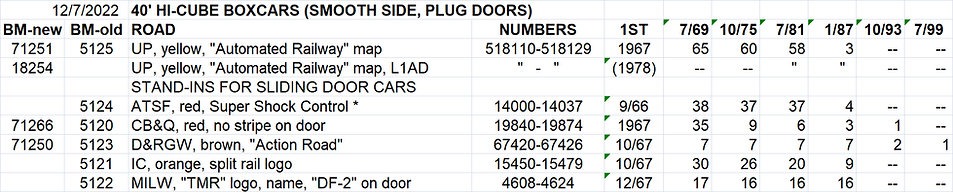
40’ PLUG DOOR BOXCARS
Refrigerator cars and insulated boxcars are useful not only for keeping commodities cold, but also for protecting them from temperature extremes. The post-war increase in canned and bottled foods spurred production of insulated box cars with no means of refrigeration. At about the same time, the hinged doors used on refrigerator cars were being replaced by plug doors. While early refrigerator cars with hinged doors had door widths of only four or five feet; the majority of plug door cars had door widths of eight or nine feet. Since the adoption of plug doors coincided with the move to fifty-foot boxcars, forty-foot cars were not constructed in large numbers.
Compared to sliding doors, plug doors were expensive and complicated, so were only used when needed for a specific purpose. While the purpose was usually insulation, some cars were equipped with plug doors to provide a smooth interior surface for loading devices. A few railroads used them on grain cars, as they leaked less than sliding doors. Although not a concern for modelers, railroad rules prohibited moving boxcars with open plug doors. An open plug door was a clearance concern, as it added about six inches to the width of a boxcar and could be easily damaged by slack action.
Most plug door boxcars carried one of two mechanical designations:
XI- An insulated box similar in design to “XM”, but either wholly or partially insulated, not equipped either with ventilating devices or for refrigeration. A car equipped with loading devices carries a designation of “XLI”.
RB- Beverage, ice, water or vinegar refrigerator, similar in design to a bunker refrigerator, except that it is not equipped with ice bunkers and with or without ventilating devices. A car equipped with loading devices carries a designation of “RBL”.
Some cars could be fitted with charcoal or alcohol heaters, which were indicated by an “H” added to the mechanical designation.

“STATE OF MAINE” INSULATED BOXCARS
EASTERN SEABOARD MODELS
Thanks to Eastern Seaboard Models, N scale modelers now have an accurate model of the popular “State of Maine” boxcars. Introduced in 2010, it is a state-of-the-art model with body mounted couplers and an etched metal running board. It features a six-foot plug door, ventilators and underfloor heaters. The model is available in just about every paint scheme ever applied to these cars, with most schemes including variations for different eras. Each road name is discussed individually below:
BANGOR & AROOSTOOK (BAR)- In 1950, the Bangor and Aroostook received 300 class XIH boxcars from the Magor Car Company. Numbered 2000-2299, they were equipped with charcoal heaters under the floor and painted in the famous red, white and blue “State of Maine Products” scheme. In 1953, Pacific Car and Foundry delivered an additional 150 cars to the Bangor and Aroostook numbered 2300-2449. These cars were used primarily for hauling Potatoes. In the 60’s, the charcoal heaters had been removed from some of the cars. Other cars were modified to handle potatoes in bulk; renumbered 2500-2579, their mechanical designation had been changed to RBLH. The Equipment Registers note that their cubic capacity had been reduced by nearly half, and they were equipped with “Conveyers and controls for loading and unloading of potatoes in bulk”. In the winter of 1969-1970, much of the Maine potato harvest froze while sitting in Penn Central’s Selkirk yard. This was a devastating blow to Maine potato farmers, and ended the shipment of Maine potatoes by rail.
CANADIAN PACIFIC (CP)- Canadian Pacific acquired 1,400 type XIH boxcars to supplement their fleet of heated refrigerator cars. The first series of 500 cars (35000-35500) was delivered in 1959 with six-foot doors and charcoal heaters. Three subsequent series followed in 1961 (35501-35800) and 1962 (35801-36100, 165000-165299) with eight-foot doors and “Thermostatically controlled alcohol heaters”. The prototypes vary from the Eastern Seaboard models in a few details. However, the model is still a decent representation of the series with six-foot doors. The Atlas and Micro-Trains models could represent the later series with eight-foot doors, but lack the ventilators. In 1978, car number 35893 was painted in a “Mandarin Orange Express” scheme to publicize an expedited Vancouver to Toronto freight service. In 1979, forty cars from the original series had their charcoal heaters removed and were renumbered to 36300-36349.
NEW HAVEN (NH)- The New Haven’s fleet of 100 cars (45000-45099) was an add-on to the Bangor and Aroostook’s 1953 order from Pacific Car & Foundry. In order to cut costs, they wore the same State of Maine scheme. By 1966, the cars were no longer equipped with heaters. The 93 cars that made it to the Penn Central merger were numbered 350500-350592. At least 77 cars made it to Conrail, however none of my Equipment Registers (1/78, 1/79 and 7/81) list cars with Conrail reporting marks. The early years of Conrail were a chaotic time, and keeping track of obsolete rolling stock was certainly low on their list of priorities.
OKEE CORPORATION (OKEX)- Okee was a northeastern manufacturer of architectural supplies. In 1971, they acquired a fleet of former Bangor and Aroostook cars which were no longer equipped with heaters. Railcarphotos.com has photo of car 6033 at Brooklyn, New York in 1976.
It is stenciled: “Return to Bay West Paper Co. Agent MILW RR. Green Bay Wisc. via service route”.

40’ PLUG DOOR BOXCARS
ATLAS, BACHMANN and MICRO-TRAINS
As plug doors arrived at about the same time as the fifty-foot boxcar became the industry standard, forty-foot plug door boxcars were less common than their fifty-foot counterparts. Three models of this body style are available in N-scale. All are old-school models with truck mounted couplers and cast on detail.
Atlas introduced a model of a 40’ plug door boxcar in 1967. Made in Austria by Roco, it was advertised as a reefer with four paint schemes that were stand-ins for other body styles. Atlas introduced an American made version in 1977; initially, many of the paint schemes offered were stand-ins for other body styles. Production was later moved to China, with more appropriate paint schemes offered.
Bachmann introduced their 40’ plug door boxcar in 1969. Made in Hong Kong, it was advertised as a mechanical refrigerator though it has no details such as louvers, grilles or fuel tanks. A number of the paint schemes offered were stand-ins for type RS ice reefers which would have had hinged doors and roof hatches.
The Micro-Trains 21000 series model of a PS-1 with plug doors was introduced in 1973. Of the many paint schemes offered over the years, most represented cars from other builders, as few plug door PS-1’s were built. Micro-Trains 21430 represents Chicago Great Western’s five-car fleet. The only other plug door PS-1’s were three series totaling 105 cars built for Merchant’s Despatch Transportation in 1960. Though they carried the same NYRX reporting marks as Micro-Trains 21440, they did not have the round “Early Bird” logo featured on the model. Micro-Trains introduced their 74000 body style in 1996; which is simply a 21000 series model without running boards.
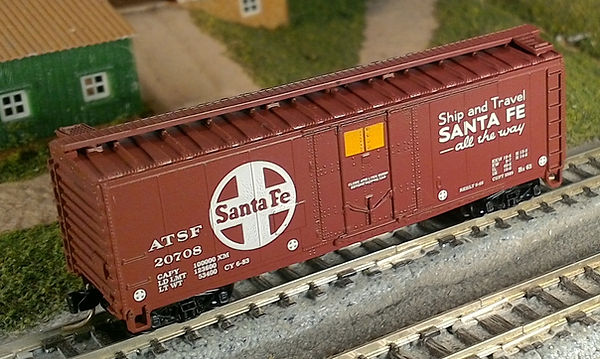
The chart below lists those models representing 40’ boxcars or refrigerator cars with plug doors eight or more feet wide. Those models representing cars with six-foot plug doors are listed in the section above, while stand-ins will be covered in a separate chart. The mechanical designation and commodity carried (when known) are indicated in parentheses in the “ROAD” column. A hashtag in the “ROAD” column indicates a post-1966 paint scheme that would likely have had their running boards removed.
Additional information on individual railroads is included below:
ATCHISON TOPEKA & SANTA FE- In the sixties, Santa Fe rebuilt some of their old boxcars with plug doors for hauling grain. The doors had small access doors which were painted orange. While the first groups of cars retained their running boards after being rebuilt, the last group of cars did not.
CANADIAN NATIONAL (CN)- According to the CDS Lettering catalog, the first thirty-five XMIH boxcars were delivered with the “Serves all Canada” maple leaf logo; the next 300 or so were delivered in a reversed large initials scheme. The remaining cars were the first to be delivered in the standard large initials scheme. In the mid-sixties many were equipped with compartmentizers and renumbered into the 291000 series.
CANADIAN PACIFIC (CP)- Atlas 3325 is numbered for XMIH boxcar series 35501-35800, which was delivered in 1961. As this series was delivered with the stacked name logo, the model represents a repainted car. However, two subsequent series built in 1962 (35801-36100, 165000-165299) were delivered with the script name. All three series featured, eight-foot doors, two side ventilators and “Thermostatically controlled alcohol heaters”. In 1965, Canadian Pacific rebuilt 250 older boxcars into a series of plug door boxcars with grain access doors. Like the Santa Fe cars, the grain doors were painted yellow.
FRUIT GROWERS EXPRESS (RBNX)- Bachmann 5009 is numbered for a series of 50’ cars and is painted orange, which I believe is incorrect.
GREAT NORTHERN (GN)- In the late sixties, Great Northern rebuilt three groups of boxcars with ten-foot plug doors. The first group (6500-6599) had smooth plug doors like Micro-Trains 74030 and 21040. The second group (6700-6924) had Camel exterior-post doors with grain doors. The third group (7000-7199) had Camel exterior-post doors without grain doors. The quantities shown in the chart include all three groups.
MERCHANTS DESPATCH (NYRX)- In 1958, Despatch Shops built 100 cars with NYRB reporting marks and New York Central’s “Earlybird” logo. The reporting marks were changed to NYRX in 1959.
PENNSYLVANIA (PRR)- The Atlas models represent Pennsy’s X54 boxcar. They were delivered with Evans “Quick Loaders” and carried a yellow “QL” on the door. Although later photos show cars with “DF” or “DFB” door markings, the Equipment Registers show them equipped with Quick Loaders throughout their service lives. Atlas has produced models with all the aforementioned door markings as well as with no markings. The Micro-Trains model represents Pennsy’s X54A boxcar, which were equipped with Pullman Standard Compartmentizers and were marked with a yellow “PC” on the door.
SOUTHERN (SOU)- Atlas 3318 is numbered for one of four series of former Fruit Grower’s Express cars. Most likely these cars were initially patched with new reporting marks and numbers, with an unknown number getting a full Southern repaint.

40’ PLUG-DOOR HI-CUBE BOXCARS
BACHMANN
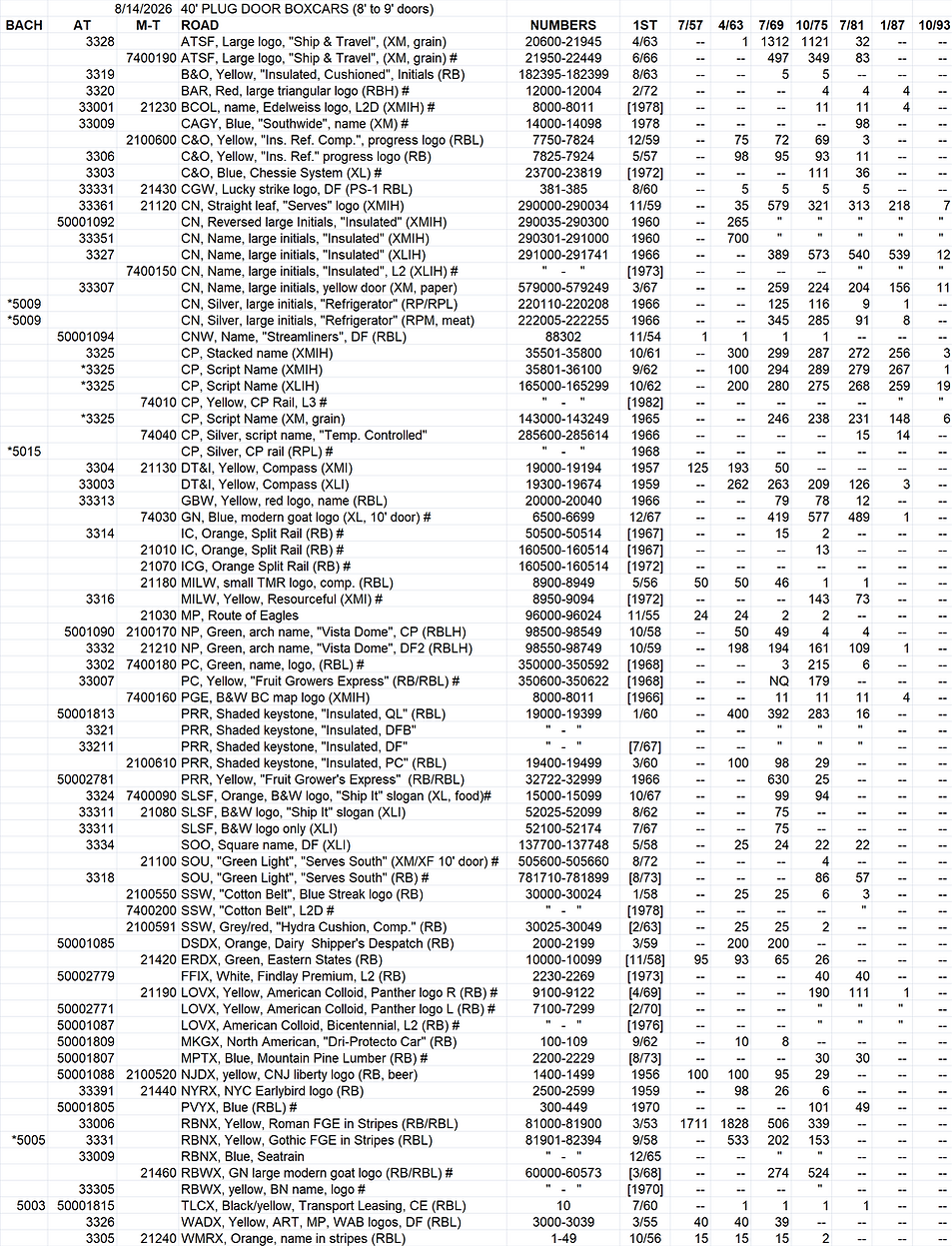
Bachmann introduced an N-scale model of a Union Pacific forty-foot BF-50-4 hi-cube boxcar with ten-foot plug doors in 1972. The original release (catalog # 5125) was a nice release for its time, but looks a bit dated today. The second “Silver Series” release (catalog #71251) has much sharper printing, while the third release (catalog # 18254) features a consolidated stencil, an ACI placard and a wheel inspection dot which dates it to 1978 or later. Only the Union Pacific owned plug-door cars, so the rest of the road names offered by Bachmann are stand-ins for sliding door cars.