

40’ DOUBLE-DOOR BOXCARS
The majority of early boxcars were equipped with six foot wide side doors which were insufficient for larger loads such as lumber, furniture and automobiles. The earliest double-door cars were “door and a half” cars with a four-foot auxiliary door to the left of the main six-foot door providing staggered ten-foot openings. This soon gave way to true double-door cars with staggered twelve-foot openings. Some cars built for automobile service had end doors on one end. End doors on only one end limited their usefulness, but putting doors on both ends would jeopardize the structural integrity of the car body.
Cars equipped for hauling automobiles carried mechanical designations of XAR, XMR or XR, indicating a car equipped with doors at least ten feet wide and equipped with permanent automobile stowing equipment. They could be with or without end doors. As they were often marked “Automobile”, these cars are listed separately in the charts below
PENNSYLVANIA X31 ROUND ROOF BOXCARS
FINE N-SCALE
The standard inside height for boxcars was nine feet, four inches in the early thirties. The Pennsylvania Railroad felt a need for higher capacity boxcars, particularly for automobile service. They developed the X31 boxcar with an interior height of ten feet and rounded edges at the roof to reduce clearance problems. These cars were constructed as both double-door cars (X31) and single-door cars (X31a), and were used by other railroads under Pennsy control.
Though no ready-to-run models are available in N-scale, cast resin kits of both versions are available from Fine N-scale. The chart below lists the roads that originally owned X31 boxcars, as well as the short lines that picked them up second hand in later years. Cars equipped to handle automobiles are listed separately; incredibly, Penn Central listed a single Pennsy X31 type XR automobile car in the October, 1975 Equipment Register.


MILWAUKEE ROAD RIBBED DOUBLE DOOR BOXCARS
FOX VALLEY MODELS
In addition to a large fleet of single door ribbed boxcars, the Milwaukee Road constructed a total of 1,100 40’ ribbed double-door boxcars. Six-hundred cars had 12’6” doors while the remaining 500 had 15’ doors.
Fox Valley Models offers an N scale model of a car with 12’6” doors. Like the single-door version, the model features truck mounted Micro-Trains couplers and non-operating doors. The model replicates an interesting feature of the prototype; a removable center post that separates the two doors. Fox Valley 9011-1 is decorated in the as-delivered scheme with the full company name inside the rectangular logo. Although it’s marked as an automobile car, the October, 1947 Equipment Register lists the entire series of 12’6” door cars as type XM cars for general service. However, the entire series of 15’ double door cars were listed as type XAR automobile cars.

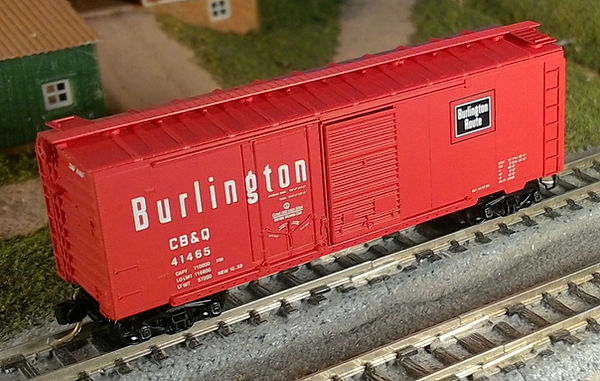
40’ PLUG /SLIDING DOOR BOXCARS
MICRO-TRAINS, AHM and CON-COR
Grain was an important but seasonal source of revenue for the railroad industry. Prior to the covered hopper construction boom of the late sixties, grain was shipped in boxcars. However, grain tended to leak out of the boxcar doors. The leakage was mitigated by placing paper seals in the doors. In the late fifties, several “granger roads” purchased fleets of boxcars equipped with auxiliary plug doors next to the sliding door. The plug door reduced grain leakage by providing a narrow door when hauling grain, and allowed for a wider door opening when used for commodities such as lumber.
Micro-Trains introduced their 22000 series model in 1973 which has since been offered in paint schemes for nearly every railroad that owned them. The model is an adaptation of their PS-1 boxcar, and features a 13’6” door opening. Only Northern Pacific and Milwaukee Road owned combo door PS-1’s, however, the cars from other builders were similar.
AHM also sold this body style in the early years of N-scale. Made in Austria by Roco, it was offered in eleven different roadnames, none of which were appropriate for the body style! Three of the schemes (FEC, GN, WM) were identical to single-door boxcars Roco made for Atlas. A few, however, were decorated in unique schemes that have not yet been offered by any other N scale manufacturer. The Roco model was later released by Con-Cor in nine roadnames. Though the quality of the paint schemes improved, only two were appropriate for the body style. (And one of those was accidental!)
In the chart below, stand-in models are listed separately. For the models that are appropriate, the door width of the prototype is given in parentheses. For the stand-in models, the type of car they represent is indicated in parentheses. Additional information on individual railroads is as follows:
BURLINGTON NORTHERN- Burlington Northern converted all of their former CB&Q cars as well as a few GN and NP cars into single door cars by simply sealing the plug doors. As this did not alter their appearance they are included in the quantities below. The running boards would have almost certainly been removed from Burlington Northern cars. Unfortunately, Micro-Trains never got around to introducing that body style before its untimely demise.
GREAT NORTHERN- Though decorated in an appropriate scheme, the Con-Cor models are numbered for a series of single-door cars.
NORTHERN PACIFIC- Micro-Trains Northern Pacific models are numbered for three series of similar cars built in the company’s Brainerd shops. Their PS-1’s were numbered 3000-3399.
