

EARLY TANK CARS
This page covers “classical” tank cars built prior to the early sixties, a time when tank car construction changed drastically. Riveting gave way to welding as new tank cars appeared without underframes or expansion domes. Finally, the 1966 legislation removing the running boards from house cars also eliminated the walkway on tank cars. Because the vast majority of tank cars are owned by the major leasing companies, researching them is difficult. The Equipment Registers provide very little physical data; usually only the weight capacity and occasionally the capacity in gallons. (One would think that the fluid capacity of a tank car would be the most 8important information). In addition, information on tank car lessees is nearly nonexistent.
The commodities hauled by tank cars could be divided into two broad categories: liquids and compressed gasses. Tank cars designed to carry liquids could be identified by one or more expansion domes atop the car. Liquids consisted primarily of fuels and chemicals, with corn syrup becoming common by the eighties. There were several mechanical designations. Tank cars used for compressed gasses can be identified by the lack of an expansion dome. Liquefied petroleum gas, chlorine and ammonia were common commodities.
Mechanical designations for tank cars were as follows:
TA- Tank car equipped with containers for hauling acid.
TG- Tank car equipped with glass-lined containers.
TL- Tank car equipped with container lined with any material other than glass.
TM- Ordinary unlined tank car for liquids.
TP- Tank car equipped with a container for compressed or liquified gasses.
An “I” included after the above designations indicated an insulated container.
Through study of old photographs and a 43-year railroad career I can provide the following tank car rules-of-thumb:
-
The majority of tank cars were plain black affairs owned by Leasing Companies.
-
Railroad- owned tank cars are usually used for company service and rarely left the home road.
-
Three-dome tank cars were not common.
I'm a paragraph. Click here to add your own text and edit me. It's easy.
THREE-DOME TANK CARS
ATLAS, BACHMANN, MICRO-TRAINS, MODEL POWER
The need for tank cars that could carry small amounts of different commodities arose in the twenties. Known as “compartment cars”, they were characterized by an expansion dome for each compartment. Two and three-compartment cars were most common, but four-, five-, and six-compartment cars were built. They were used for shipping different grades of gasoline to small distributors, chemicals and, most famously, wine. Compartment tank cars were typically small, with a capacity of 1,500 to 2,000 gallons per compartment. As with other tank car types, the vast majority of compartment tank cars wore a plain black paint scheme, though cars carrying gasoline or wine were often painted white or silver to reflect sunlight.
It is difficult to trace the history of compartment tank cars, as the AAR had no special mechanical designation, and many listing in the Equipment Registers do not mention them. The only data that is consistently listed is weight capacity, and that can be changed by replacing the trucks. Of the four major tank car leasing companies, only North American (NATX) included detailed notes on compartment cars, while Shipper’s Car Line (SHPX) noted them but did not indicate the number of compartments. General American (GATX) and Union Tank Car (UTLX) made no mention of compartment cars at all. Compartment cars comprised a small percentage of tank car fleets. In the October, 1947 Equipment Register, North American Car listed a grand total of 4,523 tank cars of which 304 (6.7%) were compartment cars. Shipper’s Car Line listed a grand total of 8,765 tank cars of which 296 (3.3%) were compartment cars.
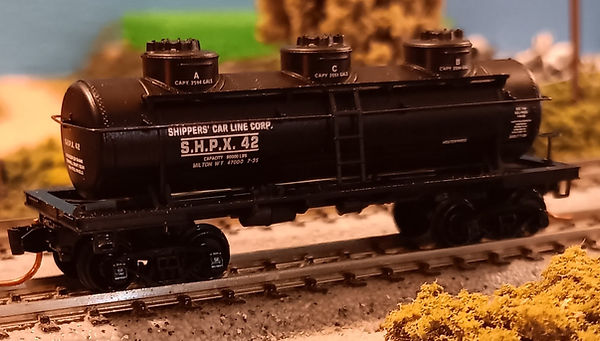
Compartment tank cars are much more common in the model world, and many N-scale manufacturers have offered them. In 2008, Micro-Trains introduced an N-scale model of a 6,000 gallon three-compartment tank car built by American Car & Foundry. While most of the paint schemes offered are pre-war “as-built” schemes, the plain-Jane Shipper’s Car Line (06600070), or General American (06600170) models would be the best choice for post-war layouts up to the mid-eighties. !n 2012, Bachmann introduced a small three-compartment car which closely resembles the Micro-Trains model, and presumably represents the same AC&F prototype.
A variety of three-dome tank car models were available in the early days of N-scale. The Bachmann model was the best of the lot; made in Hong Kong, it was a model of a longer 42’ car with metal railings and decent paint jobs. Train Shed Cyclopedia Number 12 contains a photo of a Deep Rock 8,000 gallon three-compartment tank car from North American Car that looks to be the prototype for the Bachmann model. Atlas offered two different models: catalog numbers 2291-2293 were made in Austria by Roco while 2294-2297 were made in Italy by Rivarossi. The Rivarossi model is similar to the Bachman 42’ model, while the Roco-made cars are shorter with a fatter tank. I suspect that the Roco models were actually modified from single dome tank car models. Finally, MRC and Life-Like offered a model made in Jugoslavia by Mehano in the late sixties which appear to be copies of the Roco model. The roadnames offered were stand-ins for single-dome tank cars, as neither company offered one. A Chinese made copy of the Mehano/Roco model is currently available from Model Power. Some of the Model Power models are decorated in fantasy schemes for major oil companies, and like the Mehano modles, are rather poorly done with missing or oversized data, reporting marks or road numbers.
Due to the difficulty of researching tank cars the chart below lists those models that COULD represent prototype three-compartment tank cars. In many cases the road number on the model is not listed in my Equipment Registers, so a bit of “modeler’s license” may be due here. An asterisk next to the catalog number indicates a model whose road number differs from what is listed in the Equipment Registers. Additional information for individual road names are included below. The chart includes a “LAST” column, which indicates the final year of operation for the company named on the model. The letter “N” in a date column indicates that the number series existed that year, but an exact quantity could not be determined.
AMBROSE WINE- Both Bachmann 17158 and Micro-Trains 06600120 are numbered for a car series that doesn’t appear in the July, 1947 Register. However, both Athearn and Champ Decals offer this scheme numbered for a series that is listed.
CARBON AND CARBIDE CHEMICALS- Bachmann 17155 carries a road number of 307, presumably a part of five-car series 302-306 listed in the July. 1947 Register. The company became Union Carbide in 1957, which likely changed the paint scheme on the cars (See Union Carbide below).
CONOCO- The prototype for Micro-Trains 06600060 still exists at the Railroad Museum of Oklahoma.
DEEP ROCK- Train Shed Cyclopedia Number 12 contains a photo of a Deep Rock gallon three-compartment tank car. The road numbers on the photo, Bachmann 5424 and Atlas 2294 are not listed in the July, 1947 Register. However, the Champ Decal Lettering Plan Book shows a car number that is listed. Atlas 2294 has orange lettering which I believe is incorrect.
GULF OIL- The WRNX reporting marks are those of Warren Petroleum, which Gulf absorbed in 1953.
Atlas 2296 is numbered for a three-compartment tank car listed in the April, 1963 Register. Two additional series were listed for a total of thirteen three-compartment cars.
HERCULES POWDER- The road number on Model Power 3418 is not listed as a compartment car in the July, 1947 Register. Hercules leased a series of three-compartment cars numbered 6010-6019. The Railroad Picture Archives website contains a photo showing a plain black car with yellow lettering.
KANOTEX- While the road number on Bachmann 17157 is not listed in the July, 1947 Register, it does list three series of compartment cars totaling approximately thirty-one cars. Kanotex was absorbed by Anderson Pritchard Oil Company in 1953.
MOBIL OIL COMPANY- Model Power 3459 carries the WSRX reporting marks of Socony Vacuum Oil Company’s White Star Division, which listed no compartment tank cars in the July, 1947 Register. It indicated that the cars were being remarked with the SVX reporting marks as carried by Bachmann 5426 and Atlas 2293. These models could stand in for a series of two-compartment cars inherited from Socony’s White Eagle Division (WEOX). By 1960, the company had changed their name to Mobil Oil Company and had leased a small fleet of three-compartment tank cars in a plain black paint scheme with MOBX reporting marks. Model Power 3414 carries GATX reporting marks and is presumably a fantasy scheme.
PHILADELPHIA QUARTZ- Bachmann 17151 is numbered for the larger of two series of three-compartment tank cars totaling ten cars in the July, 1947 Register.
PROTEX- Bachmann 17160 and Life-Like 7372 are numbered for a series of two three-compartment cars. An additional seven PDAX cars had capacities between 4,500 and 6,000 gallons and may also have been three-compartment cars.
QUAKER STATE- Though I suspect that Bachmann 70187 is a fantasy scheme (the reporting marks are incorrect), Quaker State did own a small fleet of three-compartment tank cars. They were replaced in the late sixties by larger four-compartment cars.n
SHELL OIL COMPANY- The July, 1947 Register listed a small series of cars that have compartments but do not indicate how many. Neither Atlas 2291 nor Bachmann 5422 are numbered for those series.
SHIPPER’S CAR LINE- Micro-Trains 06600070 features lines above and below the reporting marks, a practice that was discontinued around 1955. In 1968, Shipper’s Car Line changed their reporting marks from SHPX to ACFX. Of the 18,623 tank cars listed in the 1987 Register, only seven carried SHPX reporting marks. All twenty-four of the three-compartment tank cars listed carried ACFX reporting marks; with the July, 1999 Register listing twelve.
TEXACO- Freight Car Pictorial contains a photo of a Texaco three compartment tank car. Built in 1918, it wore a black scheme with a small “Texaco” on the right side of the car. Atlas 2292 and Bachmann 5423 are numbered for a different series and both carry incorrect “TXC” reporting marks.
UNION CARBIDE- Union carbide inherited three-compartment cars in 1957 when they absorbed the Carbon and Carbide Chemicals Company. Life Like 7765 has no reporting marks or road number, but could represent these cars. HO models with the same scheme carry CCBX reporting marks.
UNION TANK CAR LINE- The prototype for Micro-Trains 06600050 still exists at Deerfield Village. The Railcarphotos.com website contains a 1982 photo of a UTLX three-compartment car in the standard black scheme with yellow Roman lettering.
